Camp Edwards: It Started Here
Camp Edwards: It Started Here
Camp Edwards became an important starting point for the United States’ military mobilization effort. It was the first military base to undergo rapid expansion in 1940-1941.
New construction plans and methods were developed, and new techniques were implemented for administration, accounting, and large payroll distribution. All these programs proved so successful that they were duplicated in the other 159 bases undergoing rapid military mobilization.
After the war, the construction methods implemented at Camp Edwards were adopted by large developers to build new houses for the returning GIs
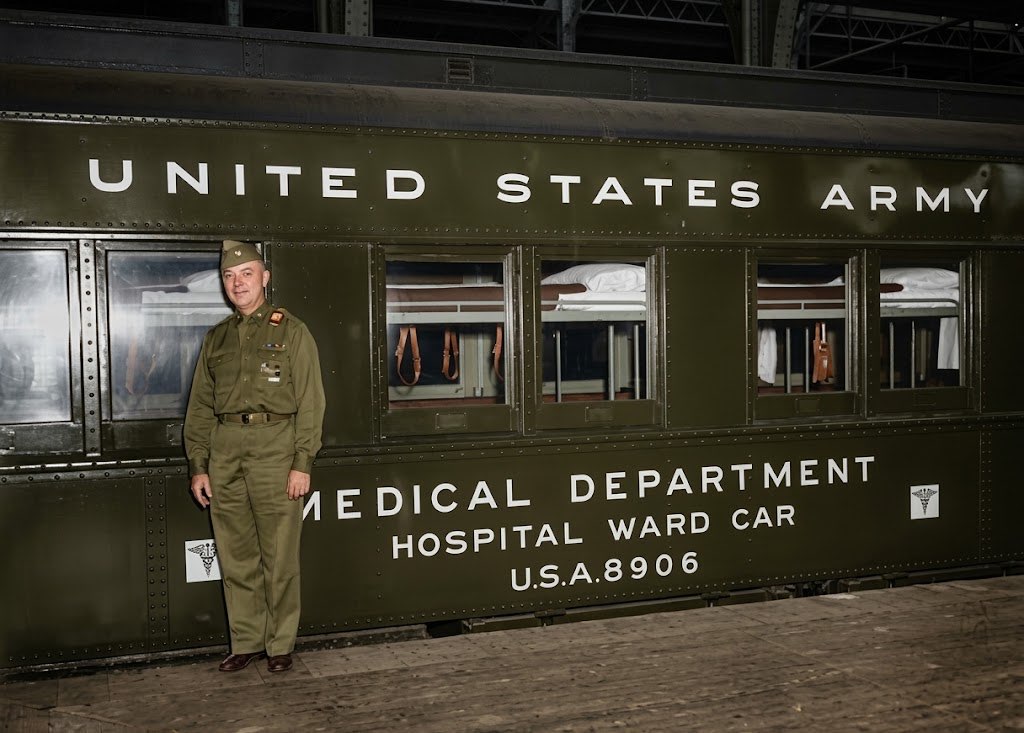
Once the U.S. entered WWII, Camp Edwards became a medical center for New England and the East Coast, developing one of the country’s largest convalescent and rehabilitation hospitals and a major medical training center to prepare soldiers, doctors, and nurses for overseas duty.
Camp Edwards constructed a major Anti-Aircraft Artillery Center and trained over 42 Battalions. This Cape Cod camp developed the nation’s first Amphibious Training Center, which trained thousands of soldiers on water landings and coastal assaults utilizing beaches throughout the Cape and the Islands.
In 1942, Camp Edwards was chosen to build a mock German village. The US Army recognized the importance of preparing its soldiers for fighting in European urban areas. The experiment was so successful that other mock villages were built throughout the country.
By the end of the war, almost 200,000 soldiers had been trained at Camp Edwards [1]
Camp Edwards, The Beginning
A Military Base in Falmouth, Massachusetts
The Massachusetts National Guard had been using Cape Cod since 1908. Over the decades, weekend soldiers had done their annual training exercises in the woods around Sandwich and Falmouth.[2]
As the Massachusetts National Guard grew in size, the state’s campsite at Fort Devens became too small. In 1935, with the support of then-Governor James Curley, the state legislature, and the approval of the War Department, almost 200,000 acres were leased. This new property covered an area that made up parts of Falmouth, Sandwich, and Bourne [3]
In 1935, the Commonwealth of Massachusetts established a camp for National Guard and Army Reserve training on its leased acreage. It was named Camp Edwards after Major General Clarence Edwards, a war hero and the Commander of the 26th Yankee Division in WWI. [4]
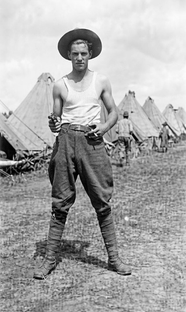
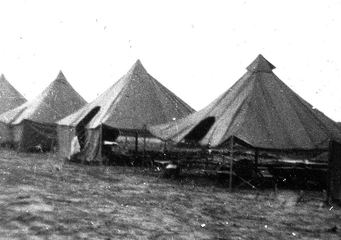
Over the next five years, the state received major funding from the Federal government’s Works Progress Administration (WPA) to build up Camp Edwards. The project employed over 500 men and established a site that had a water system, a pumping station, and a modern sewage system. They constructed 63 buildings, built two 500-foot runways, and laid the flooring for 700 tents. [5]
The Need for Rapid Construction
In 1940, with President Roosevelt’s success in getting Congress to support mobilization efforts, the military moved with uncommon speed to turn citizens into soldiers.
The U.S. Army recognized that the Camp Edwards National Guard outpost had the key requirements to develop a large base in New England. The area had an existing campsite, the surrounding land was flat, it was near transportation, and had easy access to fresh water. They leased the base for 99 years [6]
With the new authorized funds, the military brought in Brigadier General Charles Hartman to Camp Edwards to head the Construction Division. His assignment was to prepare Camp Edwards for the arrival of 30,000 troops in 120 days.[7]
Hartman was the perfect choice for this momentous task. In 1934, when Hartman was a colonel in the Quartermaster Corps, he realized the Army had outdated plans for military installations. On his own initiative, Hartman, along with a few of the men under his command, updated the post-WWI Series 600 Cantonment (military camp or garrison) plans to Series 700 Cantonment plans.
These plans went unused until he received his new assignment in 1940 to construct 23 Army cantonments. He was promoted to Brigadier General and started the Army’s rapid base construction at Camp Edwards.. [ 8]

Camp Edwards -Preparation for War
The military had never attempted this level of construction with such a tight deadline. General Hartman had to have the base ready for 30,000 soldiers in 125 days.
General Hartman chose large firms with experience in complicated projects. Under the new “cost-plus-a-fixed fee” Federal legislation, Hartman fast-tracked the contracts, and these companies began work immediately.
The Boston-based architectural firm, Charles T. Main, had its 300 architect-engineers modify and update the 700-series building plans. They created 50 copies of the new updated blueprints and sent them to the Army camps under construction. His architectural engineers had to immediately lay out the buildings’ four corners, stake out the footings, and determine where the utilities would tie in.[9]
General Hartman selected the New York-based firm, Walsh Construction Company, to begin the expansion of Camp Edwards. Within days of signing the contract, the construction company was pouring cement for barracks footings. They had advertised that jobs were available, and workers answered the call.
Thousands of men were hired to work three shifts so the camp could be ready for the arriving troops. At its peak, the workforce climbed to more than 18,000 workmen. Using the Series 700 methods developed by General Hartman, the workers were able to start and complete 30 buildings in a day. The weekly payroll totaled $750,000. [10]
General Hartman worked closely with Major Thomas Waters, who was the first camp commander. Under his watch, they also used many local contractors, including Crystal Concrete Company of Braintree and F.V. Laurence Plant of Falmouth.[11]
New methods were introduced to streamline the whole construction process. Standardized building plans were now introduced. Multiple teams of workers were divided into crews, and each had specialized assignments.
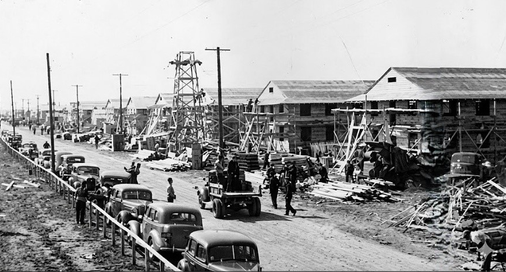
When a barracks building was started, the first crew built the foundation, the second crew framed the first floor, and the next crew framed the walls. Prefabricated windows and doors would be constructed off-site. Teams of carpenters, plumbers, electricians, roofers, and painters would then descend on the building for the finishing work.[12]
These buildings were a significant improvement over the military 600 Series cantonments. The 700 Series plans called for two-story barracks to house 63 soldiers. Major additions to the barracks included a new telephone service, central gas heating with overhead vents, inside toilets and showers, fluorescent fixtures, and ceiling tiles. A new type of fire escape was designed for 2-story hospital barracks, and all structures had termite shields.[13]
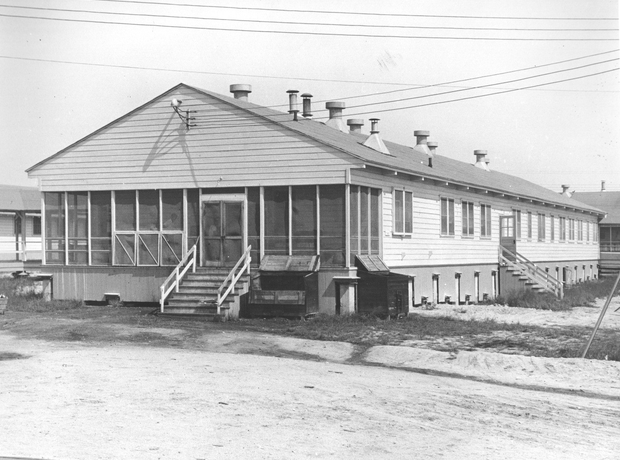
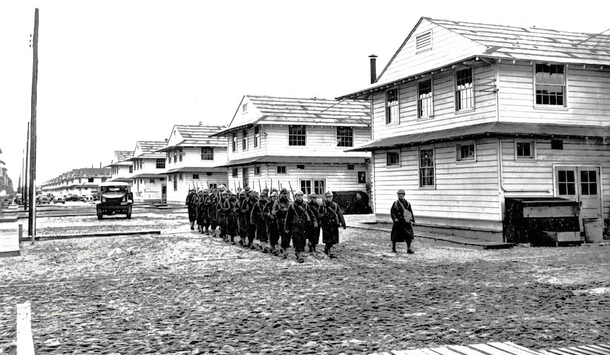
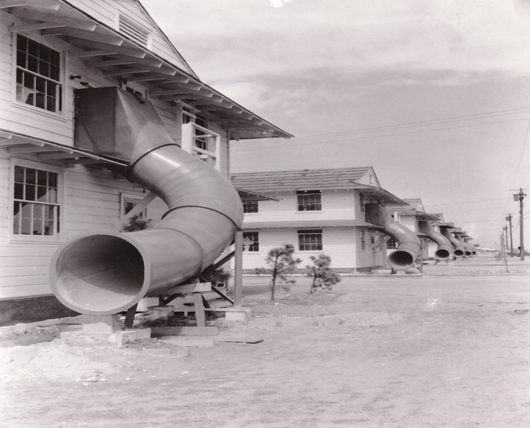
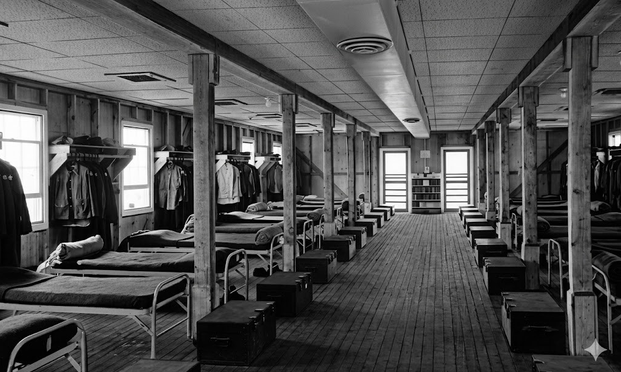
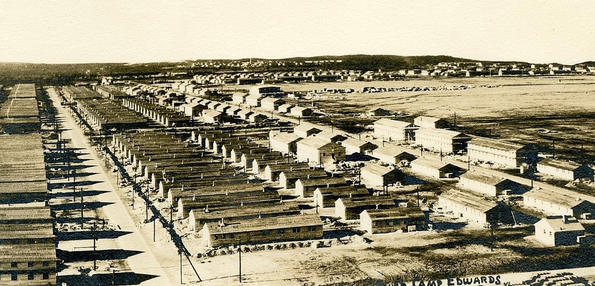
The original campsite was laid out in a square with twenty regimental blocks for infantry and artillery regiments. The new buildings were constructed around the original quadrangle. Three regimental groups were built inside the main quadrangle. Around the parade ground, administrative buildings, officer’s quarters, and a mess hall were built. Roads intersected with all key buildings, and around the outermost road were storehouses, repair shops, the hospital area, and barracks for African American infantry. [14]
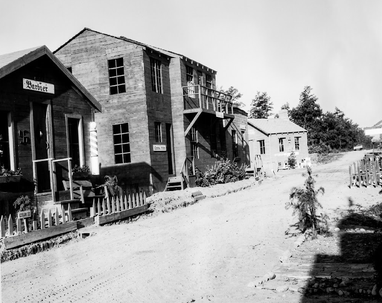
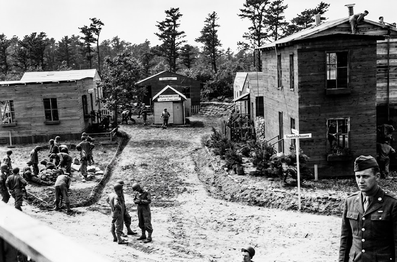
The US Army knew US soldiers would be fighting in urban European areas. The narrow streets and multi-story buildings would be death traps. A bold experiment was created at Camp Edwards. A mock German village was built to train soldiers in specialized tactics for street combat.
Camp Edwards was selected because the base was large and far away from civilian populations. Its base commanders had proven they could implement new ideas and quickly mobilize men and equipment.
The German village, nicknamed “Deutschedorf”, was built by the 150th Engineer Combat Battalion in just 3 days.It contained 15 buildings including a school house, restaurant, hotel, police headquarters and a beer garden.
Details like German style signs, decorations, and street names were added to lend an authentic look and feel to the mock village. To create realism, soldiers had to navigate live booby traps and makeshift explosive devices. Hidden operators would control silhouetted targets from windows, doors and rooftops. [15]
The Camp Edwards experiment in combat realism was so successful that other mock villages were created around the country.
Within 125 days 1,406 structures were built. They included 470 2-story wooden barracks, 184 mess halls, 54 officer’s quarters, 28 storage buildings, 82 hospital units, and 217 recreation centers [16]. This was an incredible achievement
Notes:
1. Camp Edwards Training Site, U.S. Department of Defense,
https://campedwards.ng.mil/
2. Ibid.
3. “Camp Edwards History”, Massachusetts National Guard
https://massnationalguard.org/camp edwards-history/
3. Historic American Buildings Survey
https://tile.loc.gov/storage-services/master/pnp/habshaer/ma/ma1400/ma1438/data/ma1438data.pdf, Library of Congress
4 Living New Deal
https://livingnewdeal.org/sites/camp-edwards-cape-cod-ma/
5. New England Historical Society
https://newenglandhistoricalsociety.com/camp-edwards-cape-cods-world-war-ii-city/
6. BG Charles Dudley Hartman Sr.
https://www.findagrave.com/memorial/47712299/charles-dudley-hartman
7. New England Historical Society
https://newenglandhistoricalsociety.com/camp-edwards-cape-cods-world-war-ii-city
8. Historic American Buildings Survey
https://tile.loc.gov/storage-services/master/pnp/habshaer/ma/ma1400/ma1438/data/ma1438data.pdf, Library of Congress
9. National Park Service Department of the Interior
https://tile.loc.gov/storage-services/master/pnp/habshaer/ma/ma1400/ma1438/data/ma1438data.pdf
9. Desorgher, Richard, The Magnifying Glass: Camp Edwards, In the Beginning The Enterprise Mashpee April 5, 2024
10. Cann, Donald, Galluzzo, John, “Camp Edwards and Otis Air Force Base” 2010 Arcadia Publishing
11. Massachusetts Army National Guard, “Camp Edwards History,”
https://massnationalguard.org/camp-edwards-history/
12. World War II and the U.S. Army Mobilization Program; History of 700 and 800 Series Cantonment Construction, Wasch, Diane Shaw, U.S. Dep. of the Interior, National Park Service, Cultural Resources, 1992
https://www.academia.edu/8986281/World WarII and the US Army Mobilization Program
13. Ibid.
14. Library of Congress, “Historic American Buildings Survey”, National Park Service, Dept. of Interior
https://tile.loc.gov/storage-
15. Pitts,Rick, 150th Combat Engineer Battalion of WWII, 1997-2021,
https://150th.com/index1.htm
16. Camp Edwards, Cape Cod’s World War II City New England Historical Society August 21,
http//w.w.w.newenglandhistoricalsociety.com/camp-edwards-cape-cods-world-war-ii-city
For additional reading and more detail:
Cann, Donald, Galluzzo, John, Camp Edwards and Otis Air Force Base, Acadia Publishing, 2010
Falmouth Historical Society has many historical photographs of Camp Edwards.
Related Articles
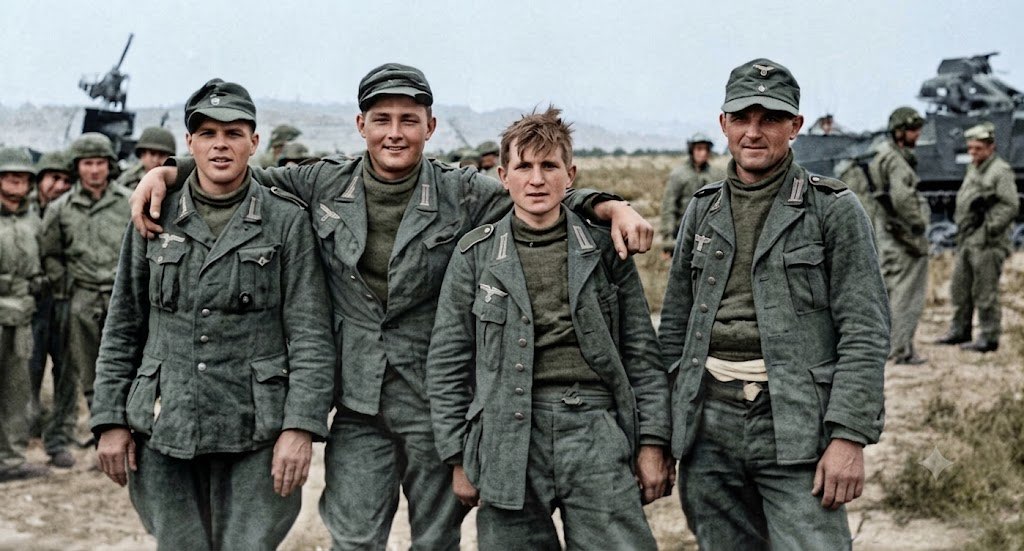
German Prisoners at Camp Edwards